
The Army Is Asking What Rate Costs
In the last week of October the Army published a market survey asking industry whether it could build and support a little under twenty one thousand infantry squad vehicles, split between a nine passenger variant and a utility variant. The buy would start in fiscal 2028
In the last week of October the Army published a market survey asking industry whether it could build and support a little under twenty one thousand infantry squad vehicles, split between a nine passenger variant and a utility variant. The buy would start in fiscal 2028 with about a hundred vehicles and run to fiscal 2036, settling at roughly two thousand a year.
The interesting part is not the quantity. It is the question. The Army asked for manufacturing cost estimates at a hundred units a year, at five hundred, at a thousand, and at fifteen hundred and above, explicitly to find where the economies of scale sit.
From the Battlefield to the Balance Sheet
That question is the one the entire industrial base argument turns on, and it is almost never asked out loud. Everyone in defense knows that unit cost falls with rate. Almost nobody publishes the curve, because the curve is the supplier's commercial position and because the buyer rarely commits to a rate long enough to make the answer binding.
Asking four points on that curve in a public notice does something useful. It converts a vague preference for volume into a number the programme office will have to defend in a budget hearing. If a thousand a year costs materially less per vehicle than two hundred, the cost of buying slowly becomes visible, and buying slowly is what the appropriations cycle does by default.
Look at the shape of the plan and the tension is already there. It opens at about a hundred vehicles in the first year and then needs to run at two thousand a year for most of a decade. That is a twentyfold ramp, and the first year sits at the very bottom of the range the survey is asking about. Whatever the cost at a hundred units turns out to be, it is the number the programme will be judged on at exactly the moment it is least favourable.
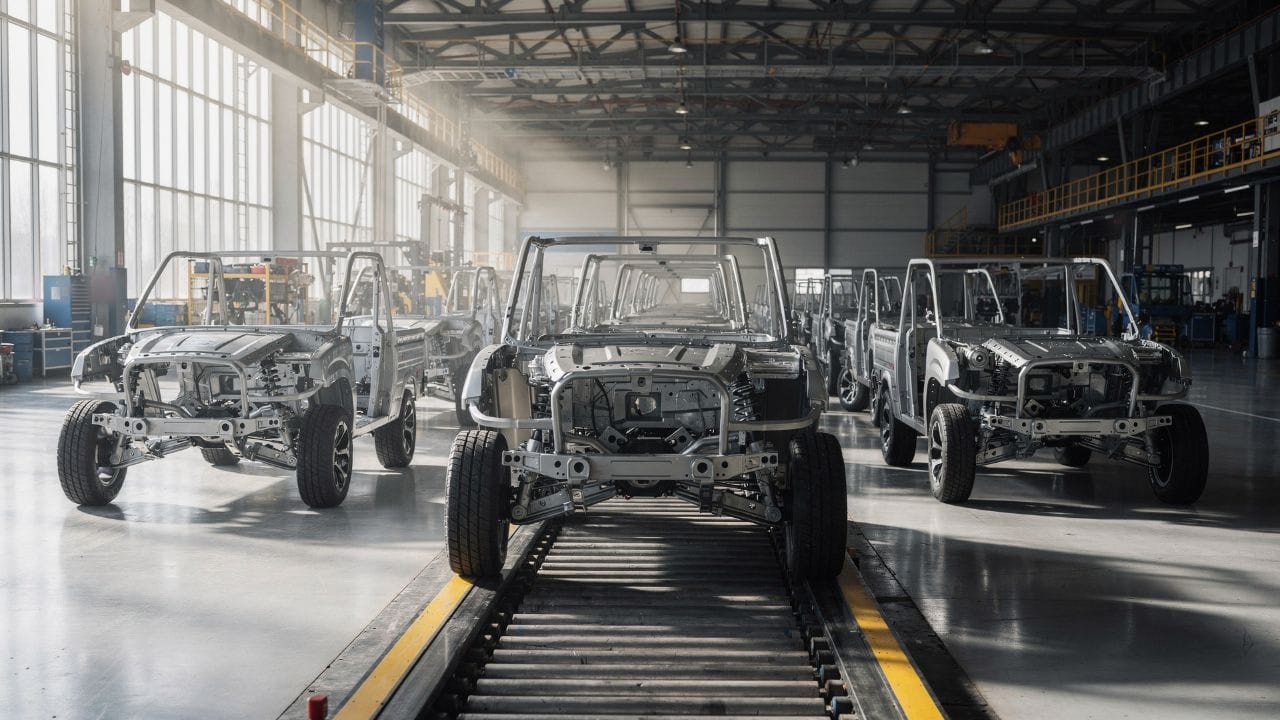
The vehicle itself is unusually well suited to this treatment. It is built on a commercial pickup platform, it weighs about five thousand pounds empty, and it does fifty five miles an hour on a road. This is not an exquisite system. It is a truck, and trucks are the one thing American industry knows how to build at rate.
The Dual-Use Reality Check
That commercial basis is the whole reason the rate question is answerable at all. A vehicle sharing an engine, a frame and a supply chain with a mass market pickup inherits an industrial base already running at hundreds of thousands of units a year. The marginal cost of another two thousand is a scheduling problem rather than a capacity problem.
Compare that with almost every other item this newsletter covers. A solid rocket motor, a forging, an interceptor seeker or a high purity metal all require capacity that exists only for defense, where going from a hundred to a thousand means a new building. Here the building exists, it belongs to the civilian economy, and defense is renting a slice of it.
The constraint moves accordingly. It is not the chassis. It is the parts that are not commercial: the armour provisions, the rollover structure, the military electrical system, the radios. Those are low volume items from specialist suppliers, and they are where a twentyfold ramp will actually bind.
The Capital Signal
The capital signal is that the buyer has started asking for the cost of rate in writing, and that is a better leading indicator than any contract announcement. A customer who wants the scale curve is a customer preparing to argue for volume.
The structural read is to watch which programmes get this treatment, because the ones built on commercial platforms are where volume is cheap and therefore where volume will actually be bought. For suppliers, the money in a programme like this is not in the vehicle. It is in the military unique content bolted onto it, which carries the margin and the qualification barrier, and which a pickup manufacturer has no particular advantage in making. Watch also whether the opening year gets funded at a hundred vehicles or at something closer to the sustained rate, since a programme that starts at the bottom of its own cost curve hands its critics the worst possible number in its first budget cycle.
Signal: The Army asked industry to price production at a hundred units a year against fifteen hundred, and that question matters more than the twenty thousand vehicle headline.
Marcus Cole, Top Margin

The Robots Stopped Being a Car Story
At the end of October the North American automation trade association published its third quarter figures. Just under eleven thousand robots were
The Power Queue Now Has a Price
On the same day at the end of October, two things were said about gas turbines. The American manufacturer reported quarterly results

The Seabed Just Got a Permit Office
In the third week of October the American oceans agency certified two deep sea mineral exploration licence applications filed by subsidiaries of

The Part Is the File Now
In the middle of October a Michigan industry organisation received a seven and a half million dollar task order to design and
Join The Strategic Reserve
Get encrypted weekly intelligence. No noise, just mission-critical data