
A Seven Year Contract Is Collateral
In late July the War Department awarded Lockheed Martin a multiyear production contract for the PAC-3 missile segment enhancement interceptor worth just under fifty-nine billion dollars over seven years. Alongside it the company described a capital program of eight to nine billion dollars through
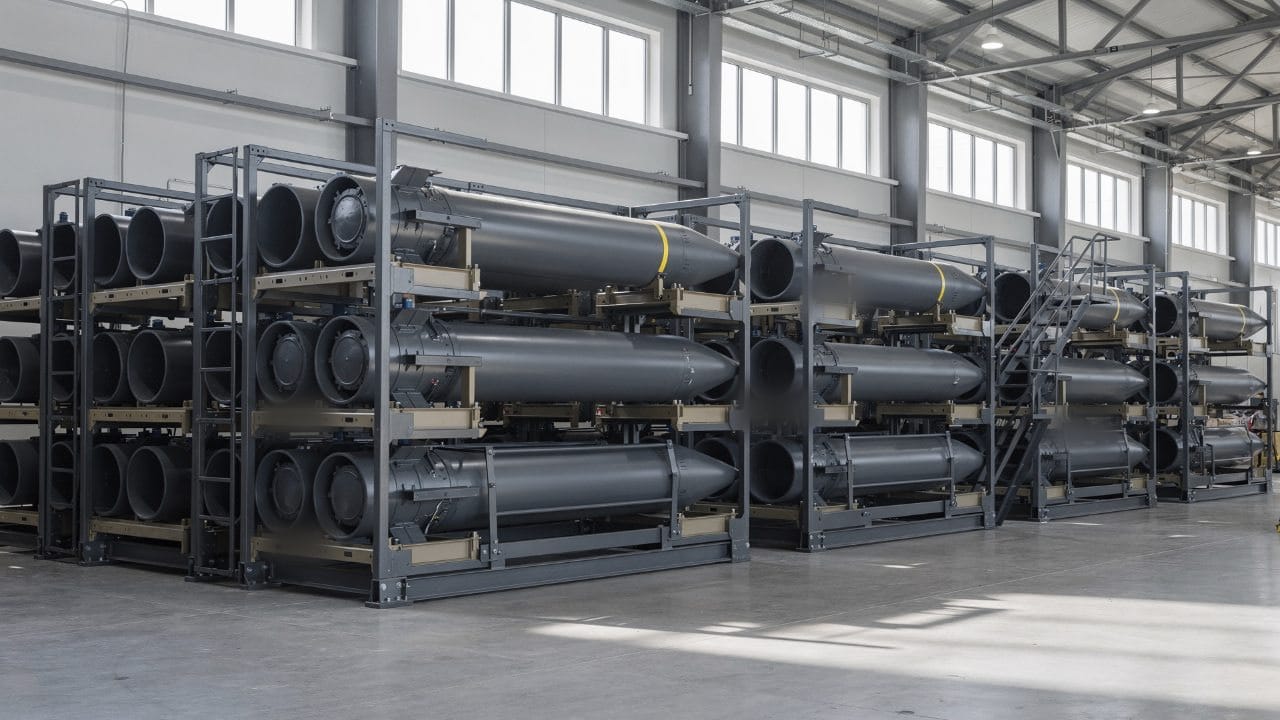
In late July the War Department awarded Lockheed Martin a multiyear production contract for the PAC-3 missile segment enhancement interceptor worth just under fifty-nine billion dollars over seven years. Alongside it the company described a capital program of eight to nine billion dollars through 2030, covering more than twenty American facilities, with the stated aim of roughly tripling interceptor capacity and adding several hundred jobs at its Camden, Arkansas plant.
Those two announcements belong together, and the order matters. The contract came first because the contract is what makes the capital program financeable. A multiyear award is not simply a large order. It is a legal instrument with properties that an annual contract does not have.
From the Battlefield to the Balance Sheet
Multiyear procurement authority exists in statute and comes with conditions. Congress must find that the arrangement either produces significant savings or provides industrial base stability that cannot be achieved otherwise, and that the design is stable and the requirement is real. In exchange the contractor gets two things that change its balance sheet.
The first is economic order quantity authority, which lets the government buy long-lead components for several years of production up front. That pulls cash into the supply chain years before the finished articles are delivered, which is precisely when a second-tier supplier needs it to justify new equipment. The second is a cancellation provision. If the government walks away mid-contract it must reimburse costs the contractor incurred in reasonable anticipation of the work. That converts a political appropriation, which can vanish, into something closer to a secured obligation.
This is why a multiyear award reliably produces a capital announcement within weeks. The prime is not being generous. It has just been handed the one thing that makes a factory expansion bankable, which is a known revenue schedule with a penalty attached to its cancellation. Historical savings estimates for these arrangements cluster in the five to ten percent range, which is real but secondary. The industrial effect is the point.
The Dual-Use Reality Check
The instrument is not military. Long-term offtake agreements with take-or-pay provisions are how mines, liquefied natural gas terminals, fertilizer plants and increasingly power generation get built, and for the same reason. Capital-intensive plants are financed against contracted revenue, not against a market forecast.
What is unusual here is the government acting as the offtaker for manufactured goods at this scale, and the technique is spreading. The same logic sits behind price floors for critical minerals, advance market commitments and the equity stakes the department has begun taking in upstream suppliers. Each is an attempt to solve the same problem, which is that a private firm will not build capacity for a buyer who can change its mind annually. Anyone watching industrial policy in energy or minerals should expect to see more of the defense toolkit appear there, because it is the same toolkit.
The Capital Signal
The capital signal is that the second and third tiers of the supply chain are where a multiyear award actually lands. The prime announces the capital program, but a large share of that money flows to the makers of rocket motors, seekers, energetics, castings, connectors and test equipment, and those firms are usually the constraint. The recent authorizations extend multiyear treatment across a list of interceptors and standoff weapons, which means several of those suppliers are being asked to expand at once.
The structural read is to distinguish contracted industrial commitments from claimed ones. The department has publicized aggregate figures for private investment across hundreds of deals without naming the contracts behind them, and an aggregate with no counterparty schedule is a communications exercise. The Lockheed case is the opposite and is worth using as the template: a named award, a stated term, a disclosed capital number and a named plant with a headcount attached. Where those four things appear together, capacity usually follows. Where they do not, the announcement is a forecast wearing the clothes of a commitment.
Signal: A multiyear contract with a cancellation penalty is collateral, and collateral is what turns a defense appropriation into a factory.
Marcus Cole, Top Margin

Someone Else Is Funding Your Copper Mine
In the third week of October a Canadian miner and a Japanese trading house took a final investment decision on a copper

The Battery Found a Better Customer Than the Car
In the third week of October a solid state battery developer announced plans for a hundred megawatt hour cell production line, targeting

The Startup Moved Into the Prime's Factory
In the middle of October a major missile maker announced a three hundred million dollar expansion of its Texas plant, part of

The Chipmaker Became the Refiner's Banker
In the third week of October one of the three large memory manufacturers said it would put strategic funding into a materials
Join The Strategic Reserve
Get encrypted weekly intelligence. No noise, just mission-critical data