
The Gating Component Is a Torpedo Tube
At the start of October an autonomy company and the Navy announced a six and a half billion dollar submarine component plant on an old steel site outside Baltimore. The company is putting in three and seven tenths billion of its own money. The Navy is
At the start of October an autonomy company and the Navy announced a six and a half billion dollar submarine component plant on an old steel site outside Baltimore. The company is putting in three and seven tenths billion of its own money. The Navy is committing up to two and nine tenths billion, with payments tied to demonstrated production rather than milestones on paper, and the government takes a reported forty percent of the new subsidiary.
The detail that tells you what this actually is sits in the product list. The first things the plant will make are precision torpedo tubes and impulse tanks. Not hulls, not reactors, not combat systems. Tubes.
From the Battlefield to the Balance Sheet
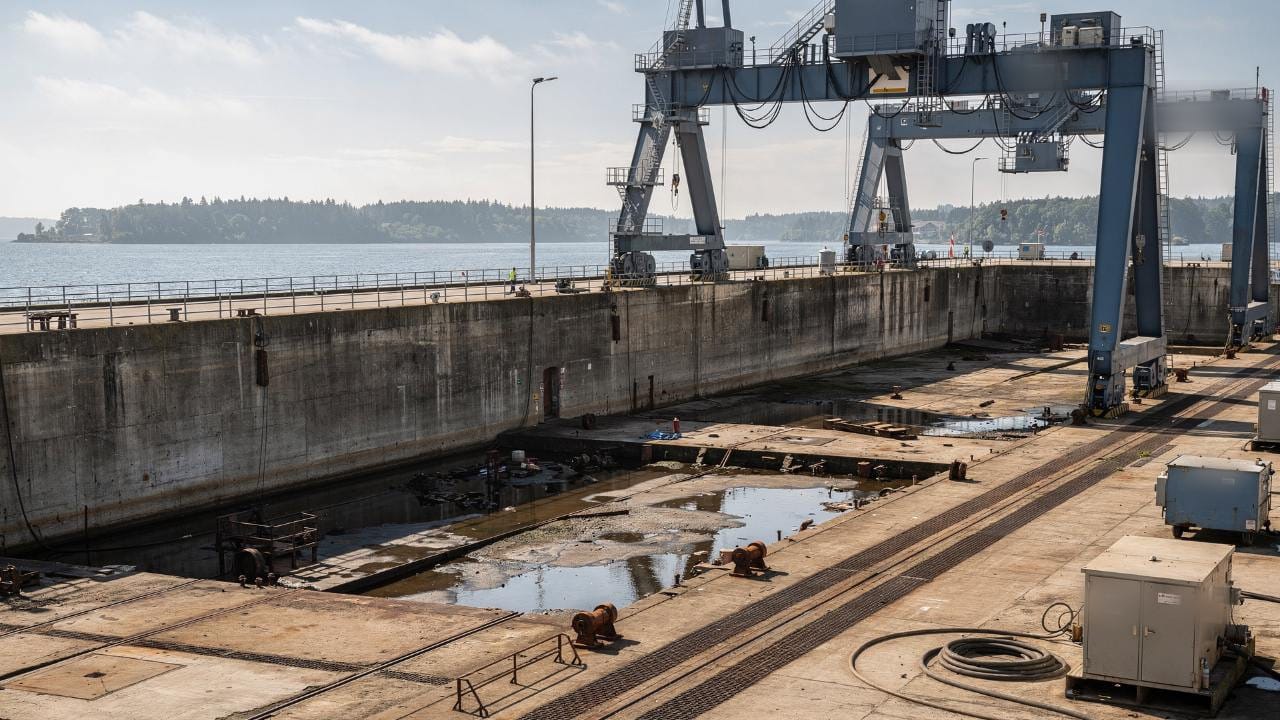
A torpedo tube is a long, thick, precisely bored pressure vessel that has to hold alignment and seal under sea pressure for decades. It is hard, it is slow, and almost nobody makes them, which is why it has become what the people running the submarine programme call a gating component. The boat cannot be finished without it, and the number of boats finished per year is set by how many arrive.
That is a different kind of constraint from the one everyone writes about. The usual story is welders, dry dock space and the two prime yards. Those are real. But a yard with free dock space and a full workforce still stops if a single long lead part is late, and the economics of that part are nothing like the economics of the yard. The tube is a machining and fabrication problem with a handful of qualified sources, each a modest business, none able to finance a second line against an order it might not get again.
So the structure of this deal is the interesting part rather than the headline number. A buyer that cannot get a part is paying a new entrant to build the capacity, taking equity in the result, and paying on output rather than on progress. That is closer to how a private investor would structure a growth investment than to how a government normally buys hardware, and it puts the taxpayer on the upside if the plant works.
The claimed effect is about nine million production hours a year and roughly a fifteen percent increase in total submarine manufacturing capacity. Those are the company's figures and the plant does not open until the end of the decade.
The Dual-Use Reality Check
There is no commercial market for torpedo tubes, so the dual-use question here runs through the site and the method rather than the product. Sparrows Point was a steel works. What it has is acreage, deep water, rail, heavy power and a region that still knows how to do large metal fabrication, and that combination is scarce and not replaceable quickly. Every heavy reshoring story in the country is competing for sites with exactly those attributes.
The method is the other transferable piece. The company describes the yard as software defined, which in practice means designing the facility and the line as a system and treating scheduling, tolerancing and quality data as the core of the business rather than paperwork around it. That is how modern automotive and electronics plants are run and it is not how most heavy defense fabrication is run. If it works it is portable to any heavy manufacturing problem, which is a bigger prize than the tubes.
The risk is ordinary. A greenfield plant on a brownfield site, with a first article four years out, in a trade where qualification takes years, is a long bet.
The Capital Signal
The capital signal is that the money has moved from the shipyard to the component tier, and the government is now willing to take equity to get a component built. Watch for the same structure appearing on the next bottleneck part, because once a buyer has done this twice it is a policy rather than a one off.
The structural read is to stop valuing the submarine build on the primes. The two assembly yards are capacity and capital constrained and will report the big contract values, while the thing that sets the delivery rate is a short list of long lead components made by companies most people cannot name. Ask any submarine story which part is gating this year, because the answer changes as each constraint is relieved and the next one appears behind it. A plant that fixes tubes will reveal whatever was second in the queue, and that is where the following six billion goes.
Signal: The submarine rate is set by a handful of long lead components, and the government has started buying equity in the companies that make them.
Marcus Cole, Top Margin

The Chipmaker Became the Refiner's Banker
In the third week of October one of the three large memory manufacturers said it would put strategic funding into a materials

The Ten Year Order Buys Certainty, Not Jets
In late October the Pentagon and the prime contractor behind the F-35 agreed on a framework covering at least eight hundred

China Is Selling Access, Not Metal
Two things happened to rare earth supply in the second week of October. European and Chinese trade officials met in Beijing and

The Constellation Has a Disposal Bill
In early October the agency building the military's low orbit satellite architecture did something new. It awarded a combined eight
Join The Strategic Reserve
Get encrypted weekly intelligence. No noise, just mission-critical data