
The Barge Is the Milestone
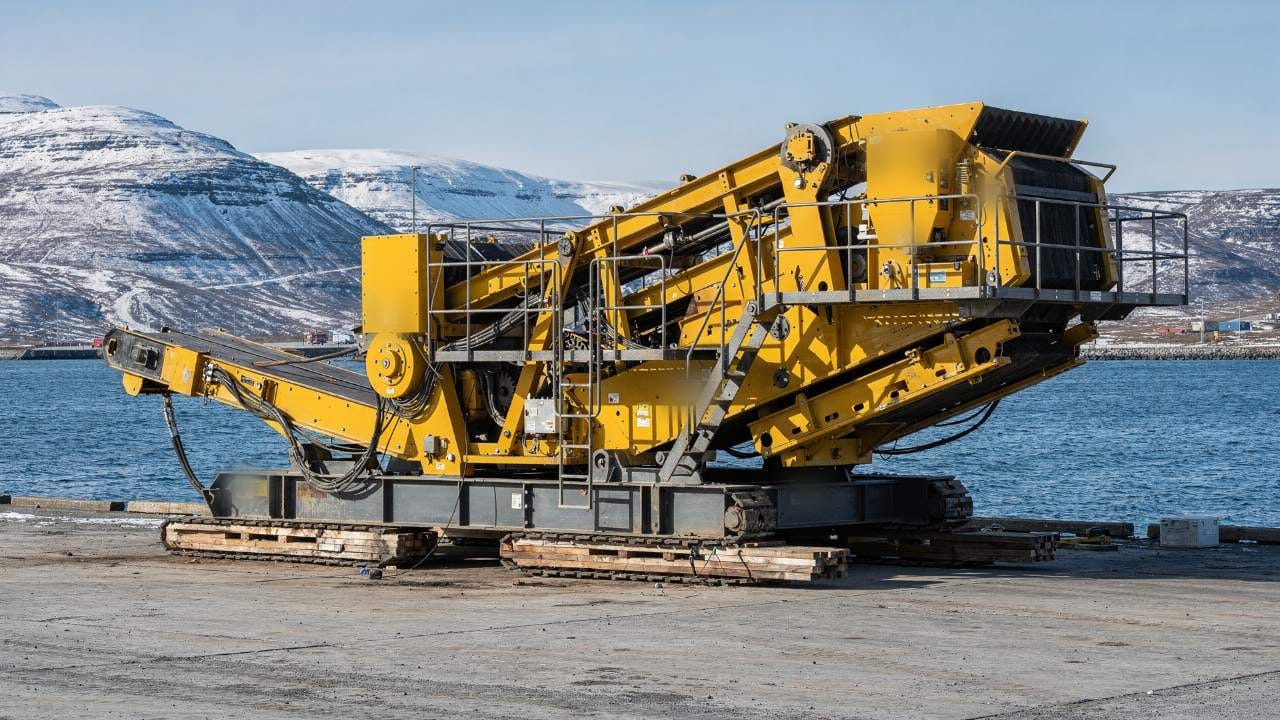
In early September about five hundred tons of processing equipment came off a barge at a port north of Anchorage, arriving in more than forty shipping containers plus oversized loads that would not fit in one. Crushing, ore sorting, milling, flotation and refining gear, funded by
In early September about five hundred tons of processing equipment came off a barge at a port north of Anchorage, arriving in more than forty shipping containers plus oversized loads that would not fit in one. Crushing, ore sorting, milling, flotation and refining gear, funded by a defense production award of roughly forty-three million dollars, destined for an antimony operation that is targeting production next year. The company says the delivery arrived ahead of schedule.
That is a duller headline than the award was. It is also the first piece of evidence in the whole sequence that anything is actually going to get built.
From the Battlefield to the Balance Sheet
The critical minerals effort has produced an enormous quantity of announcements and a very small quantity of metal. The reason is not usually money. It is the distance between a funding award and a commissioned plant, and that distance is measured in permits, long lead equipment, site works, power, water, tailings management and a workforce that has to be recruited into a remote location.
Each of those steps can stop a project, and almost none of them generate news. An award generates a press release. A permit denial generates a quiet delay. Equipment arriving on site is the first milestone in the chain that is both visible and irreversible, because nobody ships five hundred tons of processing plant to a place they do not intend to build.
This matters for how to read the sector, because the announcements are being priced as though they were production. An award is an option to build, granted at the government's cost and exercisable only if everything else lands. A plant under construction with its equipment on the ground is a different instrument entirely, with a definable commissioning date and a definable first output.
The specific project is also instructive about sequencing. The stated first product is a sulphide intermediate rather than finished metal or oxide, with the higher value forms to follow. That is the right way to build, because the simpler product qualifies faster and generates revenue while the harder step is commissioned, but it means the headline capability arrives in stages rather than at a ribbon cutting.
The Dual-Use Reality Check
Antimony is described in this context as a defense material because it hardens lead in ammunition and appears in primers and in some munitions chemistry. That is true and it is a small fraction of the tonnage. The overwhelming majority of antimony consumption is antimony trioxide used as a flame retardant synergist in plastics, textiles, wiring and electronics housings, with lead acid batteries taking most of the rest.
So the defense justification is buying a plant whose customers will be overwhelmingly commercial, which is the same structure as the government's recent moves in tungsten, alumina and copper. The department is underwriting a cost curve for industry generally and booking it against a security requirement.
That has a practical implication for whether the plant survives. A defense only material lives and dies on a single customer with a lumpy order pattern. A material that is mostly a flame retardant feedstock has a broad, steady commercial market to sell into, which is what lets a refinery run at a utilisation rate that covers its fixed costs. Ironically the civilian demand is what makes the strategic supply durable, and it is also what exposes the project to an ordinary commodity price cycle once the export restrictions of the past two years stop setting the price.
The Capital Signal
The capital signal is that the scarce asset in critical minerals is not a deposit and not an award. It is a permitted, powered, commissioned processing plant, and there are very few of them being built. Deposits are abundant, capital is currently available, and the step that keeps failing is the middle one.
The structural read is to build a checklist and apply it to every project in this space. Is the equipment ordered, is it on site, is the power arranged, is the permit final, and what is the first saleable product rather than the eventual one. A company that can answer all five is measurably further along than its peers regardless of the size of its award. Watch commissioning dates slip or hold over the next four quarters, because that is when this cohort of projects either produces or does not, and watch what happens to price once genuine Western tonnage arrives. The projects funded on a scarcity premium have to survive their own success.
Signal: In critical minerals the award is an option and the plant is the asset, and equipment landing on site is the first milestone that cannot be reversed by a press release.
Marcus Cole, Top Margin

The Chipmaker Became the Refiner's Banker
In the third week of October one of the three large memory manufacturers said it would put strategic funding into a materials

The Ten Year Order Buys Certainty, Not Jets
In late October the Pentagon and the prime contractor behind the F-35 agreed on a framework covering at least eight hundred

China Is Selling Access, Not Metal
Two things happened to rare earth supply in the second week of October. European and Chinese trade officials met in Beijing and

The Constellation Has a Disposal Bill
In early October the agency building the military's low orbit satellite architecture did something new. It awarded a combined eight
Join The Strategic Reserve
Get encrypted weekly intelligence. No noise, just mission-critical data